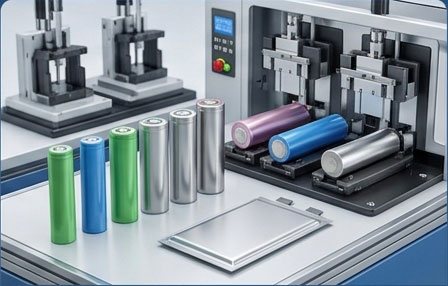
The lithium battery industry offers two dominant cell form factors — the pouch cell and the cylindrical cell — each with distinct manufacturing characteristics, performance trade-offs, and market positions. While both types store energy through the same electrochemical principles, the way they are assembled, sealed, and integrated into battery packs differs substantially. Understanding these manufacturing differences is essential for battery producers choosing a form factor, and for equipment suppliers designing production lines. HJ Equipment, which manufactures production equipment for both pouch and cylindrical cells, offers a uniquely comprehensive perspective on this comparison.
Both pouch and cylindrical cells share the same core active materials: a cathode (typically NCM, NCA, or LFP), a graphite or silicon anode, a separator, and an electrolyte. The primary difference lies in the packaging. Pouch cells use a flexible aluminum-laminated film — commonly referred to as aluminum-plastic film — that is lightweight and formable. This film must be deep-drawn (pocket-formed) to create cavities that accommodate the electrode stack, then heat-sealed along the edges to create a hermetic enclosure.
Cylindrical cells, by contrast, use a rigid metal can — typically nickel-plated steel or aluminum — that provides structural support and protection. The can is manufactured separately and the electrode jelly roll is inserted into it before the cap is welded or crimped in place. The rigid can eliminates the need for a deep-drawing process but adds weight and reduces packaging efficiency compared to pouch cells. Tab designs also differ: pouch cells use thin, flat tabs sealed through the film edges, while cylindrical cells use either a central tab or a full-tab (tabless) design where the current collector foil itself connects to the can or cap.
The formation process — the initial charge-discharge cycle that activates the cell and forms the SEI layer — differs in practical implementation between the two form factors. Pouch cells, being flexible, require controlled pressure during formation to ensure consistent electrode contact and prevent swelling. The formation fixture must clamp the cell between rigid plates with precisely controlled pressure, and the formation depth must be adjustable to accommodate cells of different thicknesses. HJ Equipment’s Pouch Cell Formation System uses a gas-liquid booster cylinder to deliver this stable, uniform pressure with depth control adjustable from 1 to 20 mm.
Cylindrical cells, being rigid, do not require external pressure during formation. However, their sealed can means that any gas generated during formation must be managed internally or through a degassing step before final sealing. The formation process for cylindrical cells focuses on precise charge-discharge current control and temperature management to ensure consistent SEI formation across the jelly roll.
The equipment portfolios for pouch and cylindrical cells diverge significantly. For pouch cells, the key processes include electrode stacking (precise alignment of cathode, anode, and separator via pick-and-place or z-folding), lamination (bonding separator to electrodes to prevent layer shift), pouch film deep-drawing, electrolyte filling, top and side sealing, formation, degassing, and final folding or trimming. HJ Equipment’s pouch cell product line covers the Pouch Cell Stacking Machine, Pouch Cell Lamination Machine, Pouch Cell Formation System, and Pouch Cell Degassing Machine, providing comprehensive coverage of the pouch cell assembly process.
For cylindrical cells, the key processes include electrode winding (high-speed, tension-controlled winding of electrode and separator strips into a jelly roll), can insertion, electrolyte filling, grooving (forming a circumferential groove to secure the cap assembly), sealing (crimping the can edge over the cap gasket), formation, and grading. HJ Equipment’s cylindrical cell product line includes the Cylindrical Cell Assembly Line, Cylindrical Cell Baking System, Cylindrical Cell PACK Assembly, Cylindrical Cell Grading System, and Cylindrical Cell Sealing Machine.
Cost analysis between pouch and cylindrical cells involves both material and processing considerations. Pouch cells offer higher packaging efficiency — the lightweight aluminum-plastic film contributes less dead weight than a metal can — but the film itself is specialized and relatively expensive, and the deep-drawing and sealing processes add complexity. Pouch cells also typically require additional structural support within the battery pack, as the flexible pouch does not provide inherent mechanical rigidity.
Cylindrical cells have a lower cell-level packaging cost due to the mature, high-volume manufacturing base for metal cans and cap assemblies, and their winding process is highly automated with low per-unit processing cost. However, the metal can adds weight, and the round shape leaves void space between cells that must be managed through coolant channels or structural fillers. At the pack level, the cost comparison depends heavily on the application: pouch cells favor energy density and form-factor flexibility, while cylindrical cells favor cell-level cost, thermal management, and mechanical robustness.
Each form factor presents unique quality control challenges. For pouch cells, the primary challenges are sealing integrity, tab alignment, and dimensional consistency. A weak seal can lead to electrolyte leakage or moisture ingress, causing capacity fade or safety issues. Misaligned tabs can create electrical hot spots. Dimensional variation in the pocket depth or cell thickness can complicate pack assembly. HJ Equipment’s pouch cell equipment addresses these challenges through ±0.02 mm machining precision and vision-based inspection systems.
For cylindrical cells, the key challenges are jelly roll alignment, weld quality for tab connections, groove depth consistency, and crimp seal integrity. A misaligned jelly roll can cause internal short circuits. Poor tab welds increase internal resistance. Inconsistent groove depth can lead to cap assembly failure. The high throughput of cylindrical lines — up to 60 pieces per minute on HJ Equipment’s systems — demands fast, reliable inline inspection to catch defects without slowing production.
Pouch cells offer higher energy density, better thermal conductivity (due to the flat profile), and design flexibility — they can be sized to fit specific product enclosures. These advantages make them the preferred choice for smartphones, tablets, laptops, and many consumer electronics devices. In the EV sector, pouch cells are used by several major OEMs, and Apple has reportedly adopted pouch cells for its consumer products due to their form-factor flexibility.
Cylindrical cells offer excellent mechanical robustness, mature high-volume manufacturing, and strong thermal management. They are the cell type of choice for Tesla’s EVs, including the 4680 cell — a larger-format cylindrical cell introduced to improve energy density, reduce cost, and simplify pack structure. Many European and Asian EV manufacturers also use cylindrical cells, drawn by their proven reliability and scalable production.
The industry adoption trend is toward diversification rather than convergence. Different applications favor different form factors, and many battery manufacturers produce both types to serve diverse customer needs. This is precisely why HJ Equipment has invested in a comprehensive portfolio covering both pouch and cylindrical cell production — to support manufacturers regardless of their form-factor strategy.
The choice between pouch and cylindrical cells is not a question of which is universally better, but which is better suited to a specific application’s requirements for energy density, cost, mechanical robustness, and thermal management. Pouch cells excel in flexibility and energy density; cylindrical cells excel in scalability, robustness, and cost. As the battery industry continues to evolve, both form factors will coexist and improve, supported by equipment manufacturers like HJ Equipment that can deliver precision, throughput, and reliability across the full spectrum of cell manufacturing processes.