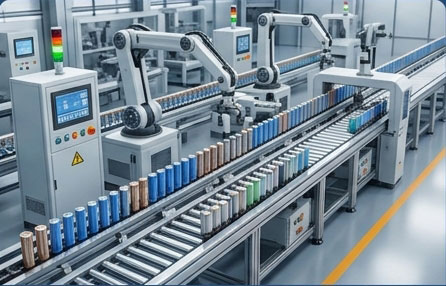
In an industry where a single defective cell can compromise the safety of an entire battery pack, production efficiency means far more than speed — it means consistency, traceability, and yield at scale. Automated production lines have become the backbone of modern lithium battery manufacturing, enabling producers to meet the exacting tolerances demanded by automotive, consumer electronics, and energy storage customers. By replacing manual and semi-automated processes with integrated, software-controlled systems, manufacturers can simultaneously increase throughput, reduce labor costs, and elevate product quality to levels that would be impossible to achieve by hand.
Consistency is the foundational benefit. Human operators introduce variability — in pressure applied, in alignment, in reaction time — that accumulates across thousands of cells and manifests as inconsistent capacity, internal resistance, and cycle life. Automated systems, by contrast, execute every motion with repeatable precision. HJ Equipment’s production lines achieve a machining precision of ±0.02 mm, ensuring that each cell is assembled, formed, and sealed under identical conditions. This consistency directly translates into a product pass rate of 99.5% or higher, reducing scrap and the cost of rework.
Yield improvement follows naturally from consistency. When every cell is processed under the same parameters, the number of cells that fall outside specification drops sharply. In formation and grading, where subtle variations in charge-discharge profiles can classify a cell as A-grade or B-grade, the stability of automated control systems ensures that more cells meet the highest performance tier.
Labor cost reduction is another significant advantage. Battery manufacturing has historically relied on large workforces, particularly in electrode winding, stacking, and visual inspection. Automated lines reduce the number of operators required per shift, lowering ongoing labor expenses and mitigating the impact of wage inflation. This is especially relevant as battery production expands into higher-cost regions such as Europe and North America, where labor cost differentials make automation economically compelling.
Traceability is increasingly non-negotiable, especially in the automotive sector where ISO 26262 and IATF 16949 standards demand comprehensive records of every manufacturing step. Automated systems log process parameters for each individual cell — including pressure, temperature, voltage, current, and timing — creating a digital thread that can be traced from raw material to finished pack. This data supports root-cause analysis when defects occur and provides the audit trail required by automotive and aerospace customers.
Programmable Logic Controllers (PLCs) serve as the brain of the automated line. They coordinate the sequence of operations, manage I/O signals, and execute the control logic that governs each production stage. Modern PLCs support high-speed communication protocols such as EtherCAT and PROFINET, enabling real-time synchronization across dozens of servo axes.
Servo motors provide the muscle. Unlike stepper motors or pneumatic actuators, servo motors offer precise position, velocity, and torque control with closed-loop feedback. This is essential for processes such as electrode stacking, where misalignment of even a fraction of a millimeter can cause internal short circuits. HJ Equipment integrates high-resolution servo systems to achieve the ±0.02 mm positioning accuracy that its customers rely on.
Machine vision inspection is the quality gatekeeper. High-resolution cameras and advanced image-processing algorithms inspect electrode edges, tab alignment, weld quality, and packaging integrity at speeds that far exceed human capability. Vision systems can detect defects as small as a few microns and classify them in real time, automatically routing defective cells for rework or rejection. This capability is critical for maintaining the 99.5% pass rate while running at production speeds of up to 60 pieces per minute.
Robotics handles material handling, cell transfer, and palletizing. Collaborative robots (cobots) work alongside operators in flexible cells, while industrial robots manage high-speed, heavy-payload transfers between production stages. Together, they eliminate the ergonomic risks of manual material handling and enable lights-out operation for segments of the production line.
The return on investment for automated battery lines can be substantial, though it varies by segment. For high-volume consumer electronics production, the throughput gains — up to 60 pieces per minute on HJ Equipment’s cylindrical cell lines — can amortize the equipment investment within two to three years, especially when combined with labor savings and yield improvements.
For automotive battery lines, where capital expenditure is higher but margins are also stronger, the ROI is driven primarily by yield and quality. A one-percentage-point improvement in pass rate on a line producing millions of cells annually can translate into millions of dollars in avoided scrap and warranty costs. Automated traceability also reduces the risk and cost of product recalls, which in the automotive industry can run into the hundreds of millions of dollars.
Energy storage lines, which produce large-format cells with longer cycle times, benefit most from the consistency and availability of automated equipment. Equipment availability of 98% or higher — a benchmark that HJ Equipment’s systems are engineered to achieve — ensures that the line produces revenue-generating output for the vast majority of available operating hours.
Despite the clear benefits, implementing automated battery production lines presents real challenges. Integration complexity is the most common hurdle: combining machines from multiple suppliers into a single, synchronized line requires careful engineering of mechanical interfaces, communication protocols, and control logic. Turnkey suppliers that can deliver fully integrated lines significantly reduce this risk.
Workforce transition is another challenge. While automation reduces the number of manual operators, it increases demand for technicians who can program, maintain, and troubleshoot PLCs, servo systems, and vision cameras. Manufacturers must invest in training or partner with equipment suppliers that offer comprehensive technical support.
Process variability from raw materials can also challenge automation. Inconsistencies in electrode coating thickness, separator width, or tab positioning can cause automated equipment to produce defects even when the machine itself is operating perfectly. This reality drives the need for closed-loop process control and adaptive algorithms that can compensate for upstream variability.
The next evolution of automated battery manufacturing is the smart factory — a fully connected, self-optimizing production environment. In a smart factory, every machine feeds real-time data into a centralized platform that uses artificial intelligence to predict equipment failures, optimize process parameters, and automatically adjust production schedules. Predictive maintenance replaces reactive maintenance, pushing equipment availability even higher. Digital twins of the production line allow engineers to test process changes virtually before deploying them, reducing commissioning time and risk.
For battery manufacturers, the path forward is clear: automation is not a luxury but a necessity. The combination of ±0.02 mm precision, up to 60 pieces per minute throughput, ≥99.5% pass rates, and ≥98% availability that HJ Equipment delivers represents the performance baseline that competitive producers will require. As battery technology continues to evolve — toward solid-state cells, higher nickel cathodes, and new form factors — the flexibility and intelligence of automated production lines will determine which manufacturers can scale profitably while maintaining the quality that their customers demand.