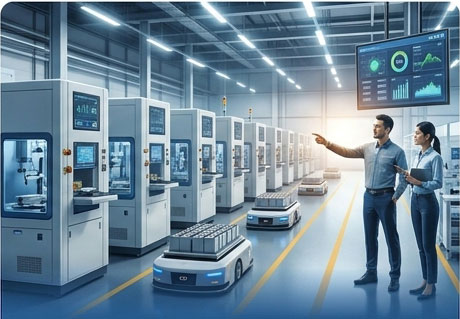
The global lithium battery manufacturing equipment market is poised for sustained, double-digit growth over the remainder of the decade, with industry analysts projecting a compound annual growth rate (CAGR) of approximately 15% through 2030. This expansion is being fueled by the rapid electrification of transportation, the global push for grid-scale energy storage, and continuous innovation in consumer electronics. For equipment manufacturers, the outlook is clear: demand for high-precision, automated production lines will intensify as battery makers scale capacity and pursue next-generation cell chemistries and form factors.
The most powerful driver of equipment demand is the global transition to electric vehicles. Major automotive markets — including China, the European Union, and the United States — have set aggressive targets for phasing out internal combustion engines, and OEMs are committing hundreds of billions of dollars to EV platforms and battery supply chains. Each new gigafactory requires a full complement of electrode manufacturing, cell assembly, formation, and grading equipment, creating a robust pipeline of orders for equipment suppliers.
Energy storage represents the second major growth engine. As renewable energy sources such as solar and wind account for a growing share of the global electricity mix, the need for stationary battery storage to smooth intermittency and provide grid stability has become urgent. Governments worldwide are offering incentives for energy storage deployment, and utility-scale battery installations are scaling from megawatt to gigawatt hours. This trend directly increases demand for large-format cell production equipment, particularly for lithium iron phosphate (LFP) cells favored for stationary storage.
Consumer electronics, while a more mature segment, continues to contribute steady demand. Foldable smartphones, wearable devices, and high-performance laptops require increasingly sophisticated cells with high energy density and fast-charging capability. These requirements push battery makers to upgrade their formation and grading equipment to achieve tighter quality tolerances.
Government policies are amplifying all of these drivers. Subsidies, tax credits, and regulatory mandates — such as the Inflation Reduction Act in the United States, the EU Battery Regulation, and China’s New Energy Vehicle policies — are reshaping battery supply chains and encouraging localized production, which in turn generates new equipment orders across regions.
China remains the world’s largest lithium battery equipment market, supported by a mature and vertically integrated battery industry. Chinese battery manufacturers dominate global production, and domestic equipment suppliers have benefited from close collaboration with cell makers on process innovation. However, as geopolitical pressures encourage supply chain diversification, Chinese equipment makers are also expanding their international presence, particularly in Southeast Asia and Europe.
Europe is emerging as the fastest-growing regional market. The EU’s ambition to achieve strategic autonomy in battery manufacturing has led to a wave of gigafactory announcements across Germany, France, Hungary, Poland, and Scandinavia. European battery producers are investing heavily in automated, environmentally compliant production lines, creating significant opportunities for equipment suppliers that can meet the EU’s stringent regulatory and sustainability standards.
North America is also expanding rapidly. Driven by the Inflation Reduction Act and commitments from major automakers, the United States is on track to build dozens of new battery manufacturing facilities. Equipment suppliers that can offer localized support, rapid installation, and compliance with US safety and labor standards are well positioned to capture this demand.
Southeast Asia represents a rising frontier market. Countries such as Indonesia, Vietnam, and Thailand are attracting battery manufacturing investment due to abundant raw material resources (particularly nickel and cobalt) and favorable labor costs. While the market is still developing, it offers substantial long-term potential for equipment manufacturers.
Automation is no longer optional in modern battery manufacturing. As cell tolerances tighten and production volumes rise, manual or semi-automated processes cannot deliver the consistency required. Fully automated lines — integrating PLC control, servo motors, robotic material handling, and machine vision inspection — are becoming the standard for new factory construction.
Intelligence and Industry 4.0 integration are the next frontiers. Battery manufacturers are increasingly connecting their equipment to manufacturing execution systems (MES) and industrial internet of things (IIoT) platforms, enabling real-time monitoring, predictive maintenance, and data-driven process optimization. Digital twins of production lines allow manufacturers to simulate changes before deploying them, reducing commissioning time and risk.
AI-based quality control is gaining traction rapidly. Machine learning algorithms can analyze vast datasets from vision inspection systems and process sensors to detect subtle defects that human inspectors or traditional rule-based systems might miss. This capability is particularly valuable in formation and grading, where early identification of underperforming cells prevents costly failures downstream.
For equipment manufacturers, the 15% annual growth projection underscores the importance of continuous innovation and geographic expansion. Companies that can deliver integrated, automated, and intelligent equipment solutions — rather than isolated machines — will capture the majority of new gigafactory orders. The ability to provide turnkey lines, from electrode coating to final grading, is becoming a key differentiator.
Equipment makers must also prioritize energy efficiency and sustainability. Battery producers face mounting pressure to reduce the carbon footprint of manufacturing, and equipment that consumes less energy or recovers waste heat will have a competitive edge. Additionally, equipment that supports the transition to new chemistries — such as solid-state batteries and sodium-ion cells — will be in high demand as these technologies mature.
The lithium battery equipment market is entering a period of exceptional opportunity. With 15% annual growth projected through 2030, the stakes are high for both established players and new entrants. Success will require a combination of technical leadership, global service capabilities, and the agility to support evolving battery technologies. Equipment manufacturers that invest in R&D, automation, and customer-centric solutions will be best positioned to thrive in this dynamic and rapidly expanding market.